As history is changed on a daily basis, and propaganda seems to wipe clean peoples memories when it comes to the past, sometimes we need to really look at what is being rewritten, and WHY.
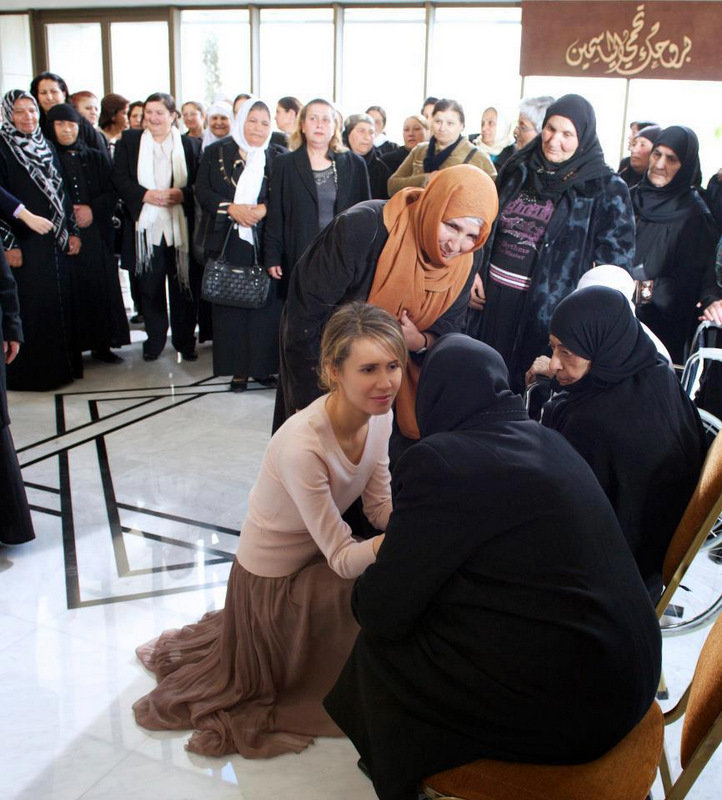
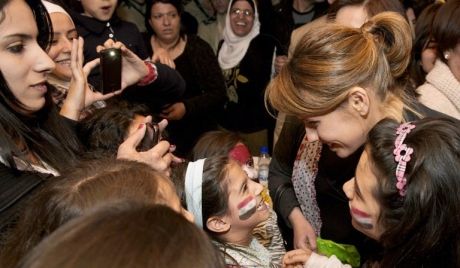
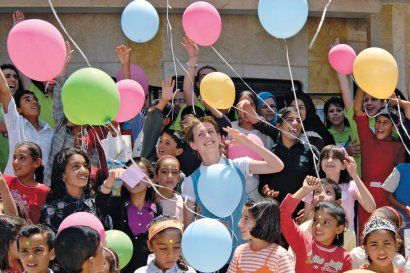
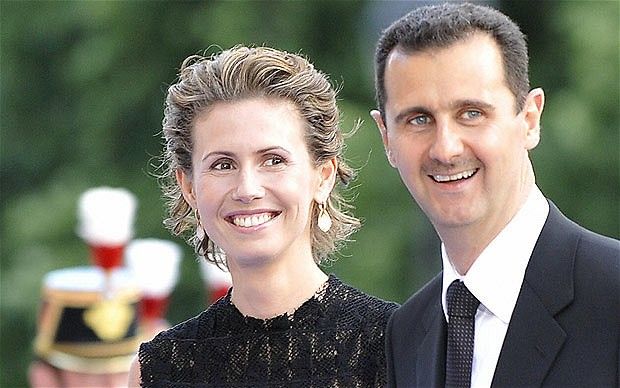
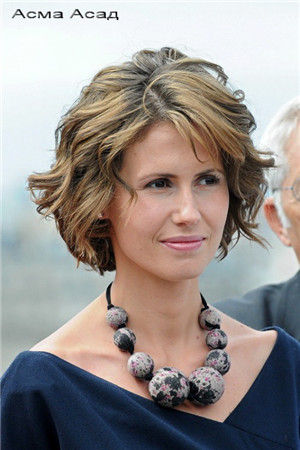
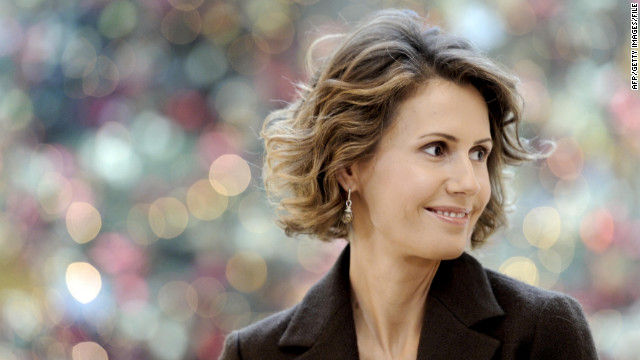
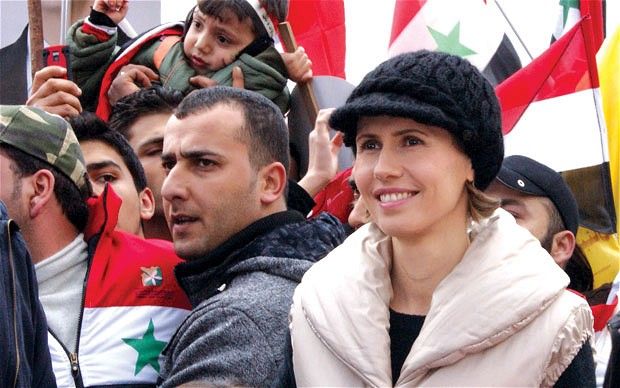
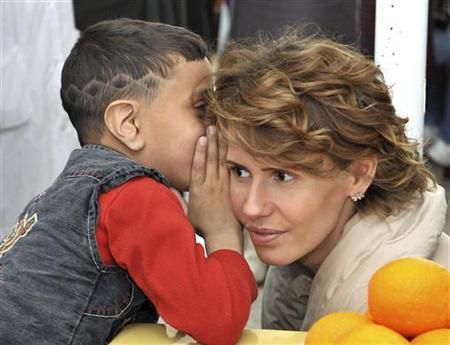
Back in 2011 the famous magazine, Vogue, did a huge article about the First Lady of Syria: Asma Al-Assad, calling her the "Lady Diana of the Middle East". When it became clear that the articles glowing tribute to the first family of Syria was NOT going to work with the propaganda that was being spun by the US and UK to destroy Al Assad, Vogue was forced to remove the article.
I've posted the entire article below... just in case it too, suddenly disappears.
This article is a vital piece of "history", if you will, a reminder of how Syria was viewed BEFORE the US began it's deliberate and destructive propaganda machine against Assad. I would like you to compare this article from Vogue in 2011, to the article published in The Guardian in 2012- AFTER the propaganda to destroy the "Assad Regime" was pushed out across the Main Stream Media.
I have put the Guardian article right below the Vogue article.
The Main Stream Media are the perpetrators of the Lies & Propaganda of the Government Controllers. The Fact remains that while Assad isn't "innocent"- and like all other world leaders is definitely part of the problem that we, the people of the world, face- he is not the "Evil" that he is painted by the US. The Template is one that the US has used over and over again, openly and even admittedly. The
, outlines this template very very clearly.
... When the
, you HAVE to look at the Template they used then, and CONTINUE to use to this very day.
.... "Arab Spring" in Syria was a carbon copy of what done in Iran in 1953. Anyone who can't see this, should definitely take a second look at the fluoride and Lithium intake.
... Just sayin'.
... and who is controlling the vast majority of US Congress.
as "a way of opening a
window into this world a little bit," conceding only that Assad's Syria
is "not as secular as we might
like." A senior editor responsible for the story told me the magazine
stood by it. A few weeks later, the article and all references to it
were removed from Vogue's website without explanation. In August, The
Hill
that U.S. lobbying firm Brown Lloyd James had been paid $5,000 per
month by the Syrian government to arrange for and manage the Vogue
article.

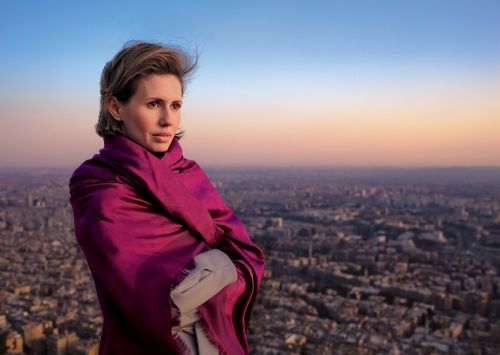
© James Nachtwey
Asma
al-Assad is glamorous, young, and very chic - the freshest and most
magnetic of first ladies. Her style is not the couture-and-bling dazzle
of Middle Eastern power but a deliberate lack of adornment. She's a rare
combination: a thin, long-limbed beauty with a trained analytic mind
who dresses with cunning understatement.
Paris Match calls her "the element of light in a country full of shadow zones." She is the first lady of Syria.
Syria is known as the safest country in the Middle East, possibly
because, as the State Department's Web site says, "the Syrian government
conducts intense physical and electronic surveillance of both Syrian
citizens and foreign visitors." It's a secular country where women earn
as much as men and the Muslim veil is forbidden in universities, a place
without bombings, unrest, or kidnappings, but its shadow zones are deep
and dark. Asma's husband, Bashar al-Assad, was elected president in
2000, after the death of his father, Hafez al-Assad, with a startling 97
percent of the vote. In Syria, power is hereditary. The country's
alliances are murky. How close are they to Iran, Hamas, and Hezbollah?
There are souvenir Hezbollah ashtrays in the souk, and you can spot the
Hamas leadership racing through the bar of the Four Seasons. Its
number-one enmity is clear: Israel. But that might not always be the
case. The United States has just posted its first ambassador there since
2005, Robert Ford.
Iraq is next door, Iran not far away. Lebanon's capital, Beirut, is 90
minutes by car from Damascus. Jordan is south, and next to it the region
that Syrian maps label Palestine. There are nearly one million refugees
from Iraq in Syria, and another half-million displaced Palestinians.
"It's a tough neighborhood," admits Asma al-Assad.
It's also a neighborhood intoxicatingly close to the dawn of
civilization, where agriculture began some 10,000 years ago, where the
wheel, writing, and musical notation were invented. Out in the desert
are the magical remains of Palmyra, Apamea, and Ebla. In the National
Museum you see small 4,000-year-old panels inlaid with mother-of-pearl
that is echoed in the new mother-of-pearl furniture for sale in the
souk. Christian Louboutin comes to buy the damask silk brocade they've
been making here since the Middle Ages for his shoes and bags, and has
incidentally purchased a small palace in Aleppo, which, like Damascus,
has been inhabited for more than 5,000 years.
The first lady works out of a small white building in a hilly, modern
residential neighborhood called Muhajireen, where houses and apartments
are crammed together and neighbors peer and wave from balconies. The
first impression of Asma al-Assad is movement - a determined swath cut
through space with a flash of red soles. Dark-brown eyes, wavy
chin-length brown hair, long neck, an energetic grace. No watch, no
jewelry apart from Chanel agates around her neck, not even a wedding
ring, but fingernails lacquered a dark blue-green. She's breezy,
conspiratorial, and fun. Her accent is English but not plummy. Despite
what must be a killer IQ, she sometimes uses urban shorthand: "I was,
like. . . ."
Asma Akhras was born in London in 1975, the eldest child and only
daughter of a Syrian Harley Street cardiologist and his diplomat wife,
both Sunni Muslims. They spoke Arabic at home. She grew up in Ealing,
went to Queen's College, and spent holidays with family in Syria. "I've
dealt with the sense that people don't expect Syria to be normal. I'd
show my London friends my holiday snaps and they'd be - 'Where did you
say you went?'"

© James Nachtwey
She
studied computer science at university, then went into banking. "It
wasn't a typical path for women," she says, "but I had it all mapped
out." By the spring of 2000, she was closing a big biotech deal at JP
Morgan in London and about to take up an MBA at Harvard. She started
dating a family friend: the second son of president Hafez al-Assad,
Bashar, who'd cut short his ophthalmology studies in London in 1994 and
returned to Syria after his older brother, Basil, heir apparent to
power, died in a car crash. They had known each other forever, but a
ten-year age difference meant that nothing registered - until it did.
"I was always very serious at work, and suddenly I started to take
weekends, or disappear, and people just couldn't figure it out,"
explains the first lady. "What do you say - 'I'm dating the son of a
president'? You just don't say that. Then he became president, so I
tried to keep it low-key. Suddenly I was turning up in Syria every
month, saying, 'Granny, I miss you so much!' I quit in October because
by then we knew that we were going to get married at some stage. I
couldn't say why I was leaving. My boss thought I was having a nervous
breakdown because nobody quits two months before bonus after closing a
really big deal. He wouldn't accept my resignation. I was, like,
'Please, really, I just want to get out, I've had enough,' and he was
'Don't worry, take time off, it happens to the best of us.'" She left
without her bonus in November and married Bashar al-Assad in December.

"What
I've been able to take away from banking was the transferable skills -
the analytical thinking, understanding the business side of running a
company - to run an NGO or to try and oversee a project." She runs her
office like a business, chairs meeting after meeting, starts work many
days at six, never breaks for lunch, and runs home to her children at
four. "It's my time with them, and I get them fresh, unedited - I love
that. I really do." Her staff are used to eating when they can. "I have a
rechargeable battery," she says.
The 35-year-old first lady's central mission is to change the mind-set
of six million Syrians under eighteen, encourage them to engage in what
she calls 'active citizenship'. "It's about everyone taking shared
responsibility in moving this country forward, about empowerment in a
civil society. We all have a stake in this country; it will be what we
make it."
In
2005 she founded Massar, built around a series of discovery centers
where children and young adults from five to 21 engage in creative,
informal approaches to civic responsibility. Massar's mobile Green Team
has touched 200,000 kids across Syria since 2005. The organization is
privately funded through donations. The Syria Trust for Development,
formed in 2007, oversees Massar as well as her first NGO, the rural
micro-credit association FIRDOS, and SHABAB, which exists to give young
people business skills they need for the future.
And then there's her cultural mission: "People tend to see Syria as
artifacts and history," she says. "For us it's about the accumulation of
cultures, traditions, values, customs. It's the difference between
hardware and software: the artifacts are the hardware, but the software
makes all the difference - the customs and the spirit of openness. We
have to make sure that we don't lose that. . . . " Here she gives an
apologetic grin. "You have to excuse me, but I'm a banker - that brand
essence."
That
brand essence includes the distant past. There are 500,000 important
ancient works of art hidden in storage; Asma al-Assad has brought in the
Louvre to create a network of museums and cultural attractions across
Syria, and asked Italian experts to help create a database of the 5,000
archaeological sites in the desert. "Culture," she says, "is like a
financial asset. We have an abundance of it, thousands of years of
history, but we can't afford to be complacent."
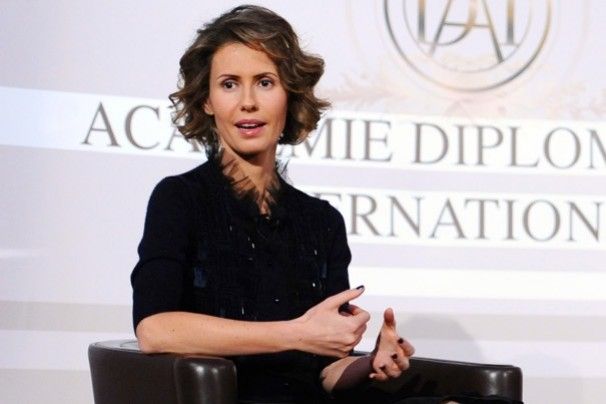
In December, Asma al-Assad was in Paris to discuss her alliance with the
Louvre. She dazzled a tough French audience at the International
Diplomatic Institute, speaking without notes. "I'm not trying to
disguise culture as anything more than it is," she said, "and if I sound
like I'm talking politics, it's because we live in a politicized
region, a politicized time, and we are affected by that."
The French ambassador to Syria, Eric Chevallier, was there: "She managed
to get people to consider the possibilities of a country that's
modernizing itself,
that stands for a tolerant secularism in a
powder-keg region, with extremists and radicals pushing in from all
sides - and the driving force for that rests largely on the shoulders of
one couple. I hope they'll make the right choices for their country and the region. "
Damascus
evokes a dusty version of a Mediterranean hill town in an Eastern-bloc
country. The courtyard of the Umayyad Mosque at night looks exactly like
St. Mark's square in Venice. When I first arrive, I'm met on the tarmac
by a minder, who gives me a bouquet of white roses and lends me a
Syrian cell phone; the head minder, a high-profile American PR, joins us
the next day. The first lady's office has provided drivers, so I shop
and see sights in a bubble of comfort and hospitality. On the rare
occasions I am out alone, a random series of men in leather jackets
seems to be keeping close tabs on what I am doing and where I am headed.
"I like things I can touch. I like to get out and meet people and do
things," the first lady says as we set off for a meeting in a museum and
a visit to an orphanage. "As a banker, you have to be so focused on the
job at hand that you lose the experience of the world around you. My
husband gave me back something I had lost."
She
slips behind the wheel of a plain SUV, a walkie-talkie and her cell
thrown between the front seats and a Syrian-silk Louboutin tote on top.
She does what the locals do - swerves to avoid crazy men who run across
busy freeways, misses her turn, checks your seat belt, points out
sights, and then can't find a parking space. When a traffic cop pulls
her over at a roundabout, she lowers the tinted window and dips her head
with a playful smile. The cop's eyes go from slits to saucers.
Her younger brother Feras, a surgeon who moved to Syria to start a
private health-care group, says, "Her intelligence is both intellectual
and emotional, and she's a master at harmonizing when, and how much, to
use of each one."
In
the Saint Paul orphanage, maintained by the Melkite - Greek Catholic
patriarchate and run by the Basilian sisters of Aleppo, Asma sits at a
long table with the children. Two little boys in new glasses and thick
sweaters are called Yussuf. She asks them what kind of music they like.
"Sad music," says one. In the room where she's had some twelve computers
installed, the first lady tells a nun, "I hope you're letting the
younger children in here go crazy on the computers." The nun winces:
"The children are afraid to learn in case they don't have access to
computers when they leave here," she says.
In the courtyard by the wall down which Saint Paul escaped in a basket
2,000 years ago, an old tree bears gigantic yellow fruit I have never
seen before. Citrons. Cédrats in French.
Back
in the car, I ask what religion the orphans are. "It's not relevant,"
says Asma al-Assad. "Let me try to explain it to you. That church is a
part of my heritage because it's a Syrian church. The Umayyad Mosque is
the third-most-important holy Muslim site, but within the mosque is the
tomb of Saint John the Baptist. We all kneel in the mosque in front of
the tomb of Saint John the Baptist. That's how religions live together
in Syria - a way that I have never seen anywhere else in the world. We
live side by side, and have historically. All the religions and cultures
that have passed through these lands - the Armenians, Islam,
Christianity, the Umayyads, the Ottomans - make up who I am."
"Does that include the Jews?" I ask.
"And the Jews," she answers. "There is a very big Jewish quarter in old Damascus."
The Jewish quarter of Damascus spans a few abandoned blocks in the old
city that emptied out in 1992, when most of the Syrian Jews left. Their
houses are sealed up and have not been touched, because, as people like
to tell you, Syrians don't touch the property of others. The broken
glass and sagging upper floors tell a story you don't understand - are
the owners coming back to claim them one day?
The presidential family lives surrounded by neighbors in a modern
apartment in Malki. On Friday, the Muslim day of rest, Asma al-Assad
opens the door herself in jeans and old suede stiletto boots, hair in a
ponytail, the word happiness spelled out across the back of her T-shirt.
At the bottom of the stairs stands the off-duty president in jeans -
tall, long-necked, blue-eyed. A precise man who takes photographs and
talks lovingly about his first computer, he says he was attracted to
studying eye surgery "because it's very precise, it's almost never an
emergency, and there is very little blood."

The
old al-Assad family apartment was remade into a child-friendly
triple-decker playroom loft surrounded by immense windows on three
sides. With neither shades nor curtains, it's a fishbowl. Asma al-Assad
likes to say, "You're safe because you are surrounded by people who will
keep you safe." Neighbors peer in, drop by, visit, comment on the
furniture. The president doesn't mind: "This curiosity is good: They
come to see you, they learn more about you. You don't isolate yourself."
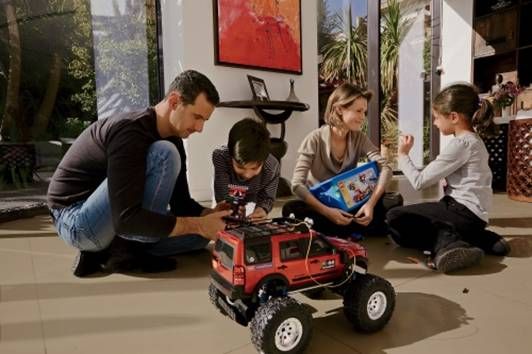
There's a decorated Christmas tree. Seven-year-old Zein watches Tim Burton's
Alice in Wonderland
on the president's iMac; her brother Karim, six, builds a shark out of
Legos; and nine-year-old Hafez tries out his new electric violin. All
three go to a Montessori school.
Asma al-Assad empties a box of fondue mix into a saucepan for lunch. The
household is run on wildly democratic principles. "We all vote on what
we want, and where," she says. The chandelier over the dining table is
made of cut-up comic books. "They outvoted us three to two on that."
A grid is drawn on a blackboard, with ticks for each member of the
family. "We were having trouble with politeness, so we made a chart:
ticks for when they spoke as they should, and a cross if they didn't."
There's a cross next to Asma's name. "I shouted," she confesses. "I
can't talk about empowering young people, encouraging them to be
creative and take responsibility, if I'm not like that with my own
children."
"The first challenge for us was, Who's going to define our lives, us or
the position?" says the president. "We wanted to live our identity
honestly."
They
announced their marriage in January 2001, after the ceremony, which
they kept private. There was deliberately no photograph of Asma. "The
British media picked that up as: Now she's moved into the presidential
palace, never to be seen again!" says Asma, laughing.
They had a reason: "She spent three months incognito," says the
president. "Before I had any official engagement," says the first lady,
"I went to 300 villages, every governorate, hospitals, farms, schools,
factories, you name it - I saw everything to find out where I could be
effective. A lot of the time I was somebody's 'assistant' carrying the
bag, doing this and that, taking notes. Nobody asked me if I was the
first lady; they had no idea."
"That
way," adds the president, "she started her NGO before she was ever seen
in public as my wife. Then she started to teach people that an NGO is
not a charity."
Neither of them believes in charity for the sake of charity. "We have
the Iraqi refugees," says the president. "Everybody is talking about it
as a political problem or as welfare, charity. I say it's neither - it's
about cultural philosophy.
We have to help them. That's why the
first thing I did is to allow the Iraqis to go into schools. If they
don't have an education, they will go back as a bomb, in every way:
terrorism, extremism, drug dealers, crime. If I have a secular and balanced neighbor, I will be safe."
When Angelina Jolie came with Brad Pitt for the United Nations in 2009,
she was impressed by the first lady's efforts to encourage empowerment
among Iraqi and Palestinian refugees but alarmed by the Assads' idea of
safety.
"My husband was driving us all to lunch," says Asma al-Assad, "and out
of the corner of my eye I could see Brad Pitt was fidgeting. I turned
around and asked, 'Is anything wrong?' "
"Where's your security?" asked Pitt.
"So I started teasing him - 'See that old woman on the street? That's
one of them! And that old guy crossing the road? That's the other one!'"
They both laugh.
The president joins in the punch line: "Brad Pitt wanted to send his security guards here to come and get some training!"
After lunch, Asma al-Assad drives to the airport, where a Falcon 900 is
waiting to take her to Massar in Latakia, on the coast. When she lands,
she jumps behind the wheel of another SUV waiting on the tarmac. This is
the kind of surprise visit she specializes in, but she has no idea how
many kids will turn up at the community center on a rainy Friday.
As
it turns out, it's full. Since the first musical notation was
discovered nearby, at Ugarit, the immaculate Massar center in Latakia is
built around music. Local kids are jamming in a sound booth; a group of
refugee Palestinian girls is playing instruments. Others play chess on
wall-mounted computers. These kids have started online blood banks, run
marathons to raise money for dialysis machines, and are working on ways
to rid Latakia of plastic bags. Apart from a few girls in scarves, you
can't tell Muslims from Christians.
Asma al-Assad stands to watch a laborious debate about how - and whether
- to standardize the Arabic spelling of the word Syria. Then she throws
out a curve ball. "I've been advised that we have to close down this
center so as to open another one somewhere else," she says. Kids' mouths
drop open. Some repress tears. Others are furious. One boy chooses
altruism: "That's OK. We know how to do it now; we'll help them."
Then the first lady announces, "That wasn't true. I just wanted to see how much you care about Massar."
As the pilot expertly avoids sheet lightning above the snow-flecked
desert on the way back, she explains, "There was a little bit of
formality in what they were saying to me; it wasn't real. Tricks like
this help - they became alive, they became passionate. We need to get
past formalities if we are going to get anything done."
Two
nights later it's the annual Christmas concert by the children of
Al-Farah Choir, run by the Syrian Catholic Father Elias Zahlawi. Just
before it begins, Bashar and Asma al-Assad slip down the aisle and take
the two empty seats in the front row. People clap, and some call out his
nickname:
"Docteur! Docteur!"
Two hundred children dressed variously as elves, reindeers, or candy
canes share the stage with members of the national orchestra, who are
done up as elves. The show becomes a full-on songfest, with the elves
and reindeer and candy canes giving their all to "Hallelujah" and "Joy
to the World." The carols slide into a more serpentine rhythm, an Arabic
rap group takes over, and then it's back to Broadway mode. The
president whispers,
"All of these styles belong to our culture. This is how you fight extremism - through art."
Brass bells are handed out. Now we're all singing "Jingle Bell Rock,"
1,331 audience members shaking their bells, singing, crying, and
laughing.
"This is the diversity you want to see in the Middle East," says
the president, ringing his bell. "This is how you can have peace!"
Spot the difference in these two pieces about the wife of the Syrian president, Bashar Hafez al-Assad:
"Asma al-Assad is a glamorous, young, and very chic - the freshest
and most magnetic of first ladies. Her style is not the
couture-and-bling dazzle of Middle Eastern power but a deliberate lack
of adornment. She's a rare combination: a thin, long-limbed beauty with a
trained analytic mind who dresses with cunning understatement... She's
breezy, conspiratorial, and fun."
Asma al-Assad
is "a good-looking woman of 35... as brisk as a prefect, as on-message
as a banker, as friendly as a new acquaintance at a friend's cocktail
party... like the kind of young Englishwoman you'd hear having lunch at
the next table at Harvey Nichols... the first lady of hell."
The first quote was from a Vogue article in March 2011 headlined
"A rose in the desert." The second from a Newsweek/Daily Beast article on Monday headlined:
"Mrs Assad duped me." The writer in both cases was Joan Juliet Buck, an experienced fashion journalist and one-time editor-in-chief of French Vogue.
Her first article, published as Syria's government started to attack
citizens, was met with a wave of criticism. Both Buck and Vogue's
editor,
Anna Wintour, were accused of taking part in a public relations campaign on behalf of the Syrian regime.
Within a month or so, the article was removed from the magazine's website. Almost a year later
Wintour broke her silence on the matter to explain
that "we were hopeful that the Assad regime would be open to a more
progressive society" but "as the terrible events of the past year and a
half unfolded in Syria, it became clear that its priorities and values
were completely at odds with those of Vogue."
Buck's contract with Vogue was not renewed and that's when she
decided to offer an a 5,000-word explanation for her original sin.
It suggests that she was the victim of of manipulation from beginning
to end. She initially rejected the assignment; claimed she didn't know
she was going to meet a murderer; and was taken in by Asma al-Assad's
glossy presentation of herself as a cosy, modern, relaxed person.
But Styleite writer, Hilary George-Parkin,
is not impressed with Buck's mea culpa. She writes:
"It is not hard to imagine this kind charade fooling a rookie
journalist. But, of course, that is hardly what Buck was at the time.
She goes on, however, to reveal further manipulation by those
surrounding the Assads, including a hacked computer, carefully-monitored
cell phone given to her at the start of her trip, and leaked emails
between PR reps discussing the need to conceal any potentially damaging
information. None of these points were mentioned in the profile...
raving about Asma al-Assad's elegant wardrobe, posh stature, and
democratic parenting style."
And Homa Khaleeli,
writing in a Guardian blog,
was also contemptuous of Buck's attempt at exculpation: "The mea culpa
is almost as disastrous as the initial interview", she writes.
"It's hard to tell if Buck asked Asma – or Bashar whom she also met –
any real questions at all. Certainly not why anyone would marry a man
whose father slaughtered 20,000 people in three weeks... She did not ask
why her phone and computer were bugged, or even why she had spotted
something that looks like a mobile prison in the souk."
Khaleeli continues: "To be fair to Buck she does explain that she had
not wanted to meet the Assads, but Vogue told her they wanted no focus
on politics at all... It seems clear that Vogue is equally to blame for
the controversy."